0-10V Output Drive Port Extender

Users Who Are Viewing This Thread (Total: 0, Members: 0, Guests: 0)

scolson

Member
Joined
Jul 16, 2021
Messages
55
Reaction score
11
Location
Bainbridge Island
With the increased dosing functionality showing up in Hydros, I'd love to make (or preferably buy) an addon device that could leverage unused 0-10V output ports to create additional 12v drive ports.

I'm envisioning a flange mounted box with a 12V power supply connector, a 6pin connector for the 0-10V outline to connect from a controller and four 2pin drive port connectors.

The electronics to do this is pretty simple, but I'd prefer to find something that is already put together and ready to use with cables etc. if it exists - I really don't enjoy working with the connectors.

Has anyone seen something like this?
 
Have you thought about using a XP8 and the Kamoer power supplies to power the dosing pumps?
 
Sure, and at some point I'll probably pull the two wifi strips in my stand and replace them with two X8s, but I have 4 unused 0-10V output jacks (16 outputs in total) that are paid for and not getting used, so if I can use those with less cost and more importantly real estate in my stand, I'd rather do that.
 
I don't know of anything already made that would take a 0-10v output and convert it to 12v. I don't think those outputs would drive a relay directly. You may be able to find a solid state relay that would work but they are expensive.
 
Sure, and at some point I'll probably pull the two wifi strips in my stand and replace them with two X8s, but I have 4 unused 0-10V output jacks (16 outputs in total) that are paid for and not getting used, so if I can use those with less cost and more importantly real estate in my stand, I'd rather do that.
Are you thinking the 0-10v output would proportionally drive 12v (e.g. 5v out of the Hydros would be 6v out of the new box) or more a binary on/off thing? If the latter, it should be pretty cheap to make something using some NPNs. And if you want to get really crazy, you could use a decoder IC to control up to 16 discrete 12-v output devices.
 
Whoops, linked to the wrong NPN kit: these are better.
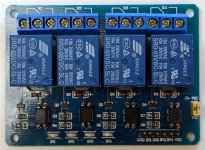
I hadn't considered using switching transistors but that would work. I was thinking along the lines of an opto-isolated relay module like this one that I picked up a few years ago when I was tinkering with a Raspberry Pi controller. The relays run at 5V so as long as the total current draw from the relays is under the 150ma limit of the 0-10V port it should work. Then I'd use the relay outputs to send power from a separate 12V power supply to the 4 output ports. You could use the same setup to switch some low load AC outlets too. PXL_20220128_174112840.jpg
 
Those optoisolators usually have trigger currents in the single-digit mA's. That should work. But no, sorry, also AFAIK, no-one has a premade box ready for you to buy off the shelf. In an ideal world, I'll get fired from my day job and I'll stand up my own company making such things.
 
I guess I'll get some 6 pin connectors and play around with it. I just don't like soldering those, my hands are not steady enough to do a good job.
 
The GX12 connectors are pretty annoying, especially since the solder cups wiggle around a bit. The cost is higher, but consider buying an assembled cable and cutting it down. Like this or this.
 
I hadn't considered using switching transistors but that would work. I was thinking along the lines of an opto-isolated relay module like this one that I picked up a few years ago when I was tinkering with a Raspberry Pi controller. The relays run at 5V so as long as the total current draw from the relays is under the 150ma limit of the 0-10V port it should work. Then I'd use the relay outputs to send power from a separate 12V power supply to the 4 output ports. You could use the same setup to switch some low load AC outlets too. View attachment 1982
Yeah I considered making a DC switch box for the 0-10v port that used this same assembly but never got around to it. Plus amount of touch labor and assembly time would increase the cost significantly. But this is exactly what I’d suggest using for sure.
 
Yeah. A friend of mine pointed them out when I mentioned the application. It is crazy flexible.
I thought of buying two of them --- one that I could hook up to 12V and another that I could hook up 24V. Most devices are either 12 or 24. These can also carry more power than the drive outputs of the hydros. Presumably, they would be able to control larger devices.

It solves most of my "hardwired" necessities. I think the only thing it lacks is power monitoring which would not be possible without it being an XP8.
 
I found another relay module that will take 0-10V inputs directly recently and came up with a design for how to use it with a common DC voltage supply for powering/controlling 4 devices that use the same DC voltage (12V or 24V). I started a new thread for this design here:

 
That Oono module is nice. It is very similar. One with relays one with FETs. It is nice that it is enclosed.
I'm just looking to make something that is more plug and play. I know some don't like the GX12 connectors. I happen to like them.

I also wanted a system where anything that can plug into the drive ports can plug into my device (without cutting off a connector).
That said, those are all bells and whistles. At the end of the day, either would work and your solution is definitely more amenable to less soldering, especially if you are not comfortable with making GX12 cables.
 
That Oono module is nice. It is very similar. One with relays one with FETs. It is nice that it is enclosed.
I'm just looking to make something that is more plug and play. I know some don't like the GX12 connectors. I happen to like them.

I also wanted a system where anything that can plug into the drive ports can plug into my device (without cutting off a connector).
That said, those are all bells and whistles. At the end of the day, either would work and your solution is definitely more amenable to less soldering, especially if you are not comfortable with making GX12 cables.

This is weird timing, I am looking to do exactly this as I want to turn a ‘dumb’ continuous doser on/off.

I have a question though, what is the difference between the FET version you linked and a traditional relay version? I mean I am familiar enough with relays but what are the advantages/disadvantages of this FET board?

Really all I am looking to do is turn the 12v doser on/off using the 0-10v outputs instead of a wifi strip.
 
This is weird timing, I am looking to do exactly this as I want to turn a ‘dumb’ continuous doser on/off.

I have a question though, what is the difference between the FET version you linked and a traditional relay version? I mean I am familiar enough with relays but what are the advantages/disadvantages of this FET board?

Really all I am looking to do is turn the 12v doser on/off using the 0-10v outputs instead of a wifi strip.
If the load is low power, FETs sometimes won’t turn off. But they tend to last longer. But for your application I’d go relays
 
This is weird timing, I am looking to do exactly this as I want to turn a ‘dumb’ continuous doser on/off.

I have a question though, what is the difference between the FET version you linked and a traditional relay version? I mean I am familiar enough with relays but what are the advantages/disadvantages of this FET board?

Really all I am looking to do is turn the 12v doser on/off using the 0-10v outputs instead of a wifi strip.
You can use a drive port to power a 12v dosing pump. I have 3 of them hooked up to drive ports.
 
Back
Top