0-10v break out box + temp/humidity sensor

Users Who Are Viewing This Thread (Total: 0, Members: 0, Guests: 0)

Anyone know if the CO2 sensor is one of these? i found 2 types on amazon but didnt know which one? OR maybe im way off base here. Thanks.
"KEYESTUDIO CCS811 Carbon Dioxide CO2 VOCs Air Quality Gas Sensor" $15 dollars
View attachment 806
"DFROBOT Gravity: Analog CO2 Gas Sensor " $55 dollars
View attachment 807

It needs to be analog- in theory the 2nd one would work. However I believe the sensor requires more than the 150ma of power that the breakout box is capable of, so you would need to power it from another source such as a 5v USB port.

I prefer a more refined one such as this: Co2 Sensor # a/co2-r2 from ACI Wall co2 Sensor 0 to 2000 ppm | eBay
(Still needs an external 24v power supply)

I currently have a new-opened box fancy one with integrated screen and calibration ports on eBay, but its overkill for our application (hence why I have it listed for sale)
 
Last edited:
Ok, so I went to your website and did some reading now I’m better informed! And I’ve come to a decision that I want to add the ambient temperature, the ambient humidity, and I would like the CO2 as well.

now I see you have a link for the inexpensive sensors however where can I get the CO2 sensor?

my other question is where do the sensors mount after they are wired to the brake out just in the cabinet area or do they go somewhere else?

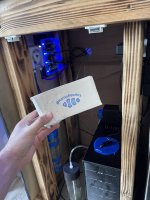
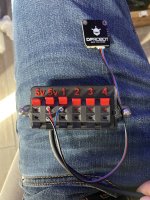
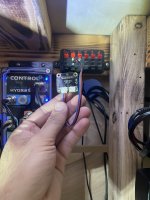
I just boxed up yours, it will go out tomorrow. I included an image of how the Ambient temperature/Humidity sensor wiring should go, and there are also step by step instructions to set that up in the get started guide. I saw your comment about a housing for the DFRobot sensor but unfortunately don't have one designed yet.

Most CO2 sensors will require using an additional power supply, as the 5v 150ma voltage supply in the 0-10v breakout is insufficient. For example the $30 one I linked earlier (Post #21) on Ebay also requires a 24v DC power supply. The physical sensors can mount wherever you like, just take airflow into account (more is better for accuracy) and then you may need to extend the wires accordingly.
 
I just boxed up yours, it will go out tomorrow. I included an image of how the Ambient temperature/Humidity sensor wiring should go, and there are also step by step instructions to set that up in the get started guide. I saw your comment about a housing for the DFRobot sensor but unfortunately don't have one designed yet.

Most CO2 sensors will require using an additional power supply, as the 5v 150ma voltage supply in the 0-10v breakout is insufficient. For example the $30 one I linked earlier (Post #21) on Ebay also requires a 24v DC power supply. The physical sensors can mount wherever you like, just take airflow into account (more is better for accuracy) and then you may need to extend the wires accordingly.
Thank you appreciate it !
 
View attachment 874
Question do the 2 Harnesses need to be connected or is it fine with one ?

Right now you are just using the Temperature side "T".

I believe if you want relative humidity "RH" you will *just* need to run the other blue wire to a 2nd channel, without connecting another red/black pair. Sensor is already powered, just need the humidity output.
 
Right now you are just using the Temperature side "T".

I believe if you want relative humidity "RH" you will *just* need to run the other blue wire to a 2nd channel, without connecting another red/black pair. Sensor is already powered, just need the humidity output.
Thank you!
 
Hello,

I would like to add a humidity sensor, but for use in a vivarium for Dendrobates (poison dart frogs). As a result I need something that would be shielded from the elements rather than a "naked sensor". As I do not want to go with something that is I2C then introduce another Digital to Analog converter, I looked around and in that form factor, I found the following:


It is costly, but looks high quality. Before I plunge, could someone let me know if that would work for certain?

Thanks for the great work guys!
 
Hello,

I would like to add a humidity sensor, but for use in a vivarium for Dendrobates (poison dart frogs). As a result I need something that would be shielded from the elements rather than a "naked sensor". As I do not want to go with something that is I2C then introduce another Digital to Analog converter, I looked around and in that form factor, I found the following:


It is costly, but looks high quality. Before I plunge, could someone let me know if that would work for certain?

Thanks for the great work guys!

Looking at the data sheet it appears compatible. Accepts a 5v input, and they provide the needed linear equation to covert voltage to RH.
 
Looking at the data sheet it appears compatible. Accepts a 5v input, and they provide the needed linear equation to covert voltage to RH.
Thank you for the quick reply.

I was mostly worried about the temperature equation, but it looks like by using their suggested setup, with a resistor, the values read (in mV) is almost linear in the range of interest (0-40 degrees C)
 
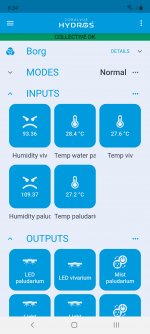
I got two of these sensors, along with Harry's breakout box. You see the result in the app. The paludarium is very wet, but I doubt above 100% humidity. Ideally I would find a way to calibrate the probes and calculate the proper formulas.

But it is still way more reliable than the humidity probes I had before. A nice thing to keep my mind at peace when traveling!

The one thing I would like to see: being able to add alert values to 0-10V analog readings.
 

Attachments

  • Screenshot_20210720-183426.jpg
    Screenshot_20210720-183426.jpg
    379.6 KB · Views: 13
I got two of these sensors, along with Harry's breakout box. You see the result in the app. The paludarium is very wet, but I doubt above 100% humidity. Ideally I would find a way to calibrate the probes and calculate the proper formulas.

But it is still way more reliable than the humidity probes I had before. A nice thing to keep my mind at peace when traveling!

The one thing I would like to see: being able to add alert values to 0-10V analog readings.

Yeah I’ve found the sensors aren’t perfect and need slight adjustment to calibrate them. Just add or remove points from the offset value.
 
I got two of these sensors, along with Harry's breakout box. You see the result in the app. The paludarium is very wet, but I doubt above 100% humidity. Ideally I would find a way to calibrate the probes and calculate the proper formulas.

But it is still way more reliable than the humidity probes I had before. A nice thing to keep my mind at peace when traveling!

The one thing I would like to see: being able to add alert values to 0-10V analog readings.

Also you can do an alert off 0-10V inputs, it’s not as direct as current inputs with built in alerts but it’s possible. You have to make a generic output that uses your 0-10V analog input (humidity or temp). There you can set thresholds that turn on that output. Don’t assign an actual output device to this generic output but do enable the advanced features. There you can use the max on time value to trigger an alert. So set that to something like 5 seconds and enable “run past max on time” and set your alert level. If your humidity goes above your threshold for more than 5 seconds you’ll get an alert.
 
Also you can do an alert off 0-10V inputs, it’s not as direct as current inputs with built in alerts but it’s possible. You have to make a generic output that uses your 0-10V analog input (humidity or temp). There you can set thresholds that turn on that output. Don’t assign an actual output device to this generic output but do enable the advanced features. There you can use the max on time value to trigger an alert. So set that to something like 5 seconds and enable “run past max on time” and set your alert level. If your humidity goes above your threshold for more than 5 seconds you’ll get an alert.
Thanks a lot for the trick Jeff, I will be definitively doing that!
 
Back
Top