Reservoir setup suggestions?

  • Thread starter Thread starter Skwerl
  • Start date Start date
  • Tagged users None

Users Who Are Viewing This Thread (Total: 0, Members: 0, Guests: 0)

Skwerl

New member
Joined
Dec 12, 2020
Messages
24
Reaction score
0
Location
CT
Hi all,

I have an RO/DI reservoir upstairs with the filter downstairs, and I can turn the filter on and off with a 0-10V output from the Hydros. There is a float at the bottom, and a float at the top of the reservoir ("Empty" and "Full"). My question is, I'd like to turn the output ON when the "empty" float closes, and OFF when the "full" float closes, but I'm not sure how to go about setting that up.
The problem is that the "empty" float opens again soon after the things starts to fill back up, but it needs to keep filling. Is there a way to turn an output ON with a "pushbutton" and then have a different input turn it off? I was thinking I could set the "empty" button/float to turn ON the output with arbitrary timer way longer than it would take to fill up and wait for the "full" input to turn it off, but I can't figure out how to do the second part...

Any help appreciated, thanks!
 
This type of setup would require the controller to remember the previous state of the sensor. This is something that is not available right now but it is on the roadmap of things to add.

The one thing you could take advantage of is a MINIMUM ON TIME.
 
I'm trying this, but I can't get to the floats to test it, so I have to wait..

I created a phantom output tied to the "full" float input that turns on when the "full" float closes. ("Phantom" because it's not tied to any actual output)
I then set the 0-10V output to come on when the "Empty" float closes, and with a 3 hour minimum on time. I then set the "Depends on" to the phantom "full" output, so hopefully it shuts off when the phantom turns on (full).

My question is: what takes precedence? The timer, or the "Depends on"?
If it's the timer, the output will stay on no matter what until the 3 hour timer finishes.
If it's the Dependency, it will turn off no matter how much time is left on the minimum on time.
 
I came up with the following until they come out with the the output type Carlos mentioned. I use a combiner output for a latch output and a combiner output to drive the actual output. I also had to use a couple of outputs to follow the empty and full inputs.

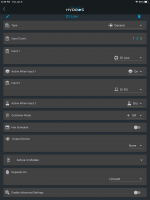
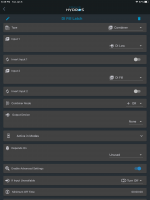
Below is a screenshot of the empty output tied to the empty float switch input. Notice there is no output device selected on this output but it can be used as a input on the combiner output. It basically is on when the empty float is active.

7C095BB5-6992-424B-8DB5-86BFBEEC505D.png

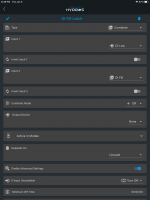
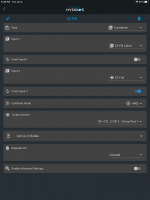
Below is a screenshot of the Latch output. It also has not output decice assigned. The way this works is that when either the empty output or the actual DI fill drice

E341886B-36B0-48B9-A3B3-3A8B038B0950.png
 

Attachments

  • 7E6CE82B-CB57-47D8-AD8C-4EF953D1CDE8.png
    7E6CE82B-CB57-47D8-AD8C-4EF953D1CDE8.png
    133.4 KB · Views: 13
  • CD477077-7C0E-4A94-84C8-E7C9BDB69835.png
    CD477077-7C0E-4A94-84C8-E7C9BDB69835.png
    122.3 KB · Views: 12
Sorry it posted before I was finished and would not let me edit the post.

Below is the screen I was on the latch output. The way it works is either the Di low or the actual DI fill output will activate it so once activated it will stay on. Until the Actual DI fill output is turned off. That will happen next.

37C9BA96-2DFC-486C-B262-996BFEAC5B46.png

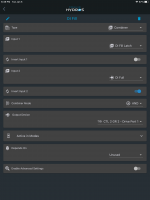
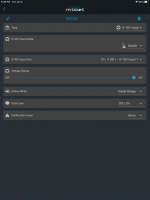
Below is a screenshot of the actual DI fill output it is also a combiner type output. The first input is the latch output. The second one is the DI full output that follows the DI full input. This is a and type combiner so it take both inputs active to activate. I inverted the DI full input so it was active when the tank was not full. Once it is full it tuns this output off which in turn turns off the latch output.


5F1B83C0-AB19-43DB-8EBD-15E37203AFEE.png

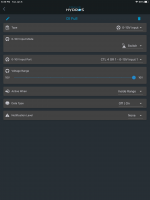
Below is the DI full output used as the input to the actual DI fill output. It is about the same as the DI low output as far as setup.

D862E3E4-7D61-471A-B4C2-FEC5D469D425.png

Hope this helps with getting you going for now.
 
My question is: what takes precedence? The timer, or the "Depends on"?
If it's the timer, the output will stay on no matter what until the 3 hour timer finishes.
If it's the Dependency, it will turn off no matter how much time is left on the minimum on time.
A dependency will always trump the timer. Here is a good example of why... You have a RODI unit running 5 hours a day and depending on a leak sensor. If the leak sensor is triggered, you want the RODI unit to stop right away and not until the 5 hours have elapsed.
 
That latch is pretty genius, Danny. I'll give it a try. I've used the same basic idea with physical relays, good call!

FYI, for maybe anyone reading this in the future, my setup as described above in post #3 does work, although when the "full" float opens again as water is removed from the reservoir, the timer is still in effect, so the output will come back on as long as the timer is active. Not ideal as the primary purpose is to keep the RO from cycling too often.
 
A dependency will always trump the timer. Here is a good example of why... You have a RODI unit running 5 hours a day and depending on a leak sensor. If the leak sensor is triggered, you want the RODI unit to stop right away and not until the 5 hours have elapsed.
Makes perfect sense described that way, Carlos, thanks!
 
That latch is pretty genius, Danny. I'll give it a try. I've used the same basic idea with physical relays, good call!

FYI, for maybe anyone reading this in the future, my setup as described above in post #3 does work, although when the "full" float opens again as water is removed from the reservoir, the timer is still in effect, so the output will come back on as long as the timer is active. Not ideal as the primary purpose is to keep the RO from cycling too often.
I am converting from the Archon to the Hydros for the things in the garage first. That includes the DI storage, fresh salt water storage and the mixing tank. Along with that my RODI unit also provides RO to the fridge for water and ice. I had it all working on the Archon. They had a float switch function that could use separate inputs for start and stop so it was a little easier to use in that sense. I also have a solenoid on the input of the RODI that needs to be opened also along with the DI fill or Mix fill solenoids. I use the combiner outputs along with a timer output that is set to turn on for 10 minutes every hour to refill the RO bladder. I also found out that the solenoids I use are not meant for constant on use. So that is the reason for the timer. I also have leak detection that will stop the outputs when a leak is detected. So far I have got as far as moving the actual outputs to the hydros for this but they are still commanded on via a relay on a sense port for both the DI and mix tanks. The hold up is I have been trying to track the water level with pressure sensors on the Hydros and I am still woking out the kinks. I can always use float switches instead of the sensors if I have to though.
 
I've thought about using pressure to measure the level of my sump, with a transducer at the top of a 1" pvc pipe (or larger) and the bottom dipped into the sump. We used to use this method to measure hydraulic oil level in a sealed tank, but the sensor was just mounted to the huge tank, not a tube. The issue I found is that as the level rises, the exponentially increasing pressure inside the tube opposes the level rising in the tube to the point that at the higher levels, an inch or so of water level is barely measurable with any kind of affordable sensor. I'm sure the non-linearity could be solved in software, but I'm not savvy enough for that either, so a float switch it is!

I use solenoid valves on the inlet and outlet as well, and while nothing said they weren't rated for 100% duty, I got concerned how really hot they got. So I put some big ol' 10 watt resistors in-line to limit the current and they are nice and barely warm now being on for almost the whole day with no noticeable effect on function.

Side note, I used your setup described above almost verbatim and it works perfectly, thanks!
 
Back
Top