

JeffB418
HYDROS Expert
The XP8 itself can only power devices up to 8A each, or a total of 14A for the total XP8... so what do you do when you have a device that uses more power? or want to offload a larger device to a different circuit? The following tutorial and device can help you in those situations.
Amazon sells this relay box that is used for controlling shop vacs when a power tool is turned on, but you can also use this with Hydros to provide control over higher current devices: Amazon.com
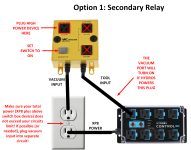
There are a couple main ways to use this box, the first one allows you to slave the control of a higher current device (up to 12A) off a XP8 AC port as shown here. Note in this configuration you do not use the two right plugs and you set the switch to ON. The vacuum side of the switch box will turn on if the tool input side is turned on from the XP8. The XP8 sees barely any power since the load is all isolated to the vacuum relay side. This configuration also allows you to plug the vacuum input side into a separate circuit as well to prevent overloading your primary circuit.
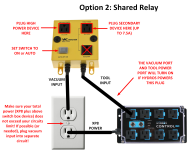
Another option is to take advantage of the tool power relay. Here you can run both a high powered 12A device off the vacuum relay side, and also power a second device off the XP8 side as well. Note that your limit on the tool power side will be set by the max current of an XP8 PLUS the total max of the XP8 itself. In this case you can use either ON or AUTO. If you use ON, vacuum power will engage regardless if there is power draw on the tool power plug. If you use AUTO, vacuum power will only engage if there is power draw on the tool power port. This setup is handy if you wanted to split larger heaters for a larger system. For example putting a 800W heater on the vacuum power port (8.5A) and then a 600W heater on the tool power port (5A). In this configuration you could at minimum still use Hydros to monitor the 600W heater's power usage, but be blind to the 800W heaters draw since it is isolated. But this would atleast give you some idea of issues with atleast 1 of the heaters and/or the iVAC switch box itself. I personally would recommend this type of redundancy and running 2 heaters split.
Finally, as stated above... make sure you know how much power you are using and your limits on your circuits! Split up power usage across multiple circuits in large draw cases to keep a safe system.
FOR LARGER LOADS, 3 PHASE DEVICES, OR HIGH VOLTAGE DEVICES:
If you have VERY large loads that the above solution wont work for, the same company makes a different product that requires some DIY. This product works like above but requires the user to wire the load side of the circuit. This device supports voltages up to 600VAC and currents up to 40A. So for those heavy duty chillers, pumps, heaters, and more... this is your boy!
Amazon sells this relay box that is used for controlling shop vacs when a power tool is turned on, but you can also use this with Hydros to provide control over higher current devices: Amazon.com
There are a couple main ways to use this box, the first one allows you to slave the control of a higher current device (up to 12A) off a XP8 AC port as shown here. Note in this configuration you do not use the two right plugs and you set the switch to ON. The vacuum side of the switch box will turn on if the tool input side is turned on from the XP8. The XP8 sees barely any power since the load is all isolated to the vacuum relay side. This configuration also allows you to plug the vacuum input side into a separate circuit as well to prevent overloading your primary circuit.
Another option is to take advantage of the tool power relay. Here you can run both a high powered 12A device off the vacuum relay side, and also power a second device off the XP8 side as well. Note that your limit on the tool power side will be set by the max current of an XP8 PLUS the total max of the XP8 itself. In this case you can use either ON or AUTO. If you use ON, vacuum power will engage regardless if there is power draw on the tool power plug. If you use AUTO, vacuum power will only engage if there is power draw on the tool power port. This setup is handy if you wanted to split larger heaters for a larger system. For example putting a 800W heater on the vacuum power port (8.5A) and then a 600W heater on the tool power port (5A). In this configuration you could at minimum still use Hydros to monitor the 600W heater's power usage, but be blind to the 800W heaters draw since it is isolated. But this would atleast give you some idea of issues with atleast 1 of the heaters and/or the iVAC switch box itself. I personally would recommend this type of redundancy and running 2 heaters split.
Finally, as stated above... make sure you know how much power you are using and your limits on your circuits! Split up power usage across multiple circuits in large draw cases to keep a safe system.
FOR LARGER LOADS, 3 PHASE DEVICES, OR HIGH VOLTAGE DEVICES:
If you have VERY large loads that the above solution wont work for, the same company makes a different product that requires some DIY. This product works like above but requires the user to wire the load side of the circuit. This device supports voltages up to 600VAC and currents up to 40A. So for those heavy duty chillers, pumps, heaters, and more... this is your boy!
Last edited: