

KWolfe81
Active member
So my overflow, a bean animal style is decently quiet. But, with this idea, it could be SILENT! And the thing holding me back is the lack of an API in Hydros. Hear me out.
Quick review for Bean Animal Overflows (which is what I have): there's a primary drain that should always be 100% full, underwater, and under siphon. There should, however, be just slightly more water entering the overflow than what the primary drain can handle, and the excess water drains down a secondary drain. The design is quiet because most of the water moves without drawing any air in the pipes (air = noise), and the little water in the secondary drain doesn't cause any gurgling.
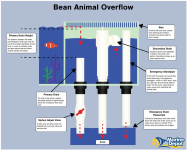
This works really well, especially if you're diligent about changing the primary drain adjustment valve. However, I've found that I don't adjust it enough. Sooner or later, something screws up the nice balance, and either the overflow box starts running dry (LOTS of noise!) or lots of water starts draining into the secondary (modestly noisy).
Wouldn't it be great if we could keep the water level in the overflow exactly between the primary and secondary drain outlets? Well, the water level in the overflow is directly related to the speed of water entering the overflow, which is set by... the return pumps! If I had two level sensors (providing a high and low water level mark), I could throttle the return pump speeds up and down to keep the water level on point.
Ok, I can possibly do this already with generic inputs and a bit of Wave Engine Mode Schedule hackery, but the right approach is for a separate microcontroller receiving the level sensor inputs to send drive speeds to the Wave Engine digitally. Why use the microcontroller? To automatically calculate the drive speeds necessary such that the time between hitting high and low marks is maximized (vs. hard fixed pump drive speeds I'll have to program in the Wave Engine).
I might pull one of my return pumps off the Wave Engine to test this method (using the 0-10v input on the OEM pump controller), but that means putting the old power supply back in. Boo! Instead, where's that sweet sweet API you guys keep whispering about?
Quick review for Bean Animal Overflows (which is what I have): there's a primary drain that should always be 100% full, underwater, and under siphon. There should, however, be just slightly more water entering the overflow than what the primary drain can handle, and the excess water drains down a secondary drain. The design is quiet because most of the water moves without drawing any air in the pipes (air = noise), and the little water in the secondary drain doesn't cause any gurgling.
This works really well, especially if you're diligent about changing the primary drain adjustment valve. However, I've found that I don't adjust it enough. Sooner or later, something screws up the nice balance, and either the overflow box starts running dry (LOTS of noise!) or lots of water starts draining into the secondary (modestly noisy).
Wouldn't it be great if we could keep the water level in the overflow exactly between the primary and secondary drain outlets? Well, the water level in the overflow is directly related to the speed of water entering the overflow, which is set by... the return pumps! If I had two level sensors (providing a high and low water level mark), I could throttle the return pump speeds up and down to keep the water level on point.
Ok, I can possibly do this already with generic inputs and a bit of Wave Engine Mode Schedule hackery, but the right approach is for a separate microcontroller receiving the level sensor inputs to send drive speeds to the Wave Engine digitally. Why use the microcontroller? To automatically calculate the drive speeds necessary such that the time between hitting high and low marks is maximized (vs. hard fixed pump drive speeds I'll have to program in the Wave Engine).
I might pull one of my return pumps off the Wave Engine to test this method (using the 0-10v input on the OEM pump controller), but that means putting the old power supply back in. Boo! Instead, where's that sweet sweet API you guys keep whispering about?

 )
)