Auto Top Off Control, Using One 0-10V Input

Users Who Are Viewing This Thread (Total: 0, Members: 0, Guests: 0)

Hkinkade

New member
Joined
Jun 4, 2025
Messages
19
Reaction score
2
Location
Calif
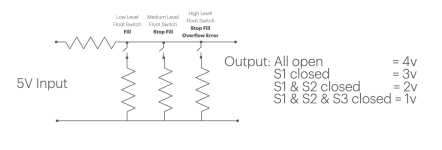
I'm considering using one of the four 0-10v inputs to control my auto top off. There will be three float switches hooked to a single 0-10v input through a voltage divider. the voltage divider will create a 3v input when the low level switch is closed, then a 2v input when the low and fill float switch are closed, and 1V input when the low level switch, fill switch, and overfill switches are closed. In this way I don't need to use multiple o-10v inputs for each switch.

Here is my assumption - I can trigger different outputs for three distinct voltages on a single 0-10 volt input channel. Is this true? Has anyone done something similar?

Also, it would be nice to be able to trigger a message if I had some odd voltages. This could allow additional diagnostics for failed switches. So my question is - what are the allowable voltage trigger points, only 1V, 2V . . .or can the triggers be set to 1.5V. . . ? What's the trigger tolerance e.g. 1V +/-.2V?

My circuit is below. I can provide resistor values for anyone who may be interested.


1750011080072.png
 
I'm considering using one of the four 0-10v inputs to control my auto top off. There will be three float switches hooked to a single 0-10v input through a voltage divider. the voltage divider will create a 3v input when the low level switch is closed, then a 2v input when the low and fill float switch are closed, and 1V input when the low level switch, fill switch, and overfill switches are closed. In this way I don't need to use multiple o-10v inputs for each switch.

Here is my assumption - I can trigger different outputs for three distinct voltages on a single 0-10 volt input channel. Is this true? Has anyone done something similar?

Also, it would be nice to be able to trigger a message if I had some odd voltages. This could allow additional diagnostics for failed switches. So my question is - what are the allowable voltage trigger points, only 1V, 2V . . .or can the triggers be set to 1.5V. . . ? What's the trigger tolerance e.g. 1V +/-.2V?

My circuit is below. I can provide resistor values for anyone who may be interested.


View attachment 5186
You know you can use just one float switch for the ATO full and also use the advanced settings to setup maximum on time, minimum on time, minimum off time and maximum off time. If you set a maximum on time with run past max on time set to off it will only run for that long before shutting off and sending an alert. It will have to get a wet sence on the ATO water level input before it will come back on you will have to intervene. With minimum off time and maximum on time it will limit the amount of top off that can occur in a given time frame. The maximum off time will not turn on the output but will send an alert if that is setup if it stays off longer than the set time so you can check it.
 
Bump - here's the fundamental question I have.

Can I trigger different outputs for three distinct voltages on a single 0-10 volt input channel?
 
You can setup three switch inputs on a single 0-10v input but only one will trigger at a time. That may be a problem depending on what they are for. If push buttons where only one at a time is pressed there would be on issue.With float switches only one would trigger so You would have to make sure the order they are in and test to see what happens if more than one are on at a time.
 
You can setup three switch inputs on a single 0-10v input but only one will trigger at a time. That may be a problem depending on what they are for. If push buttons where only one at a time is pressed there would be on issue.With float switches only one would trigger so You would have to make sure the order they are in and test to see what happens if more than one are on at a time.
Thanks Danny. That's the designed concept of the voltage divider. I can design it to get 1v steps. For example all switches open yields 4v, when the first float switch trips it's now 3v, when the first and then the second switch is tripped it will be 2V. . .

If the Hydros could trigger at smaller increments it would be possible to detect faults in switches. The voltage regulator could be designed to give an intimidate voltage if when the first float switch sticks open, but then the level gets high enough to trip the second float switch. This voltage would be between 3 and 2V. But, to do this the hydros would have to have finer trigger points (less than 1 volt).

I'm assuming the trigger points for the Hydros are in 1V increments with some tolerance window. Do you know what the trigger increments are and associated tolerance on these triggers?

Thanks for the help you have provided!
 
Thanks Danny. That's the designed concept of the voltage divider. I can design it to get 1v steps. For example all switches open yields 4v, when the first float switch trips it's now 3v, when the first and then the second switch is tripped it will be 2V. . .

If the Hydros could trigger at smaller increments it would be possible to detect faults in switches. The voltage regulator could be designed to give an intimidate voltage if when the first float switch sticks open, but then the level gets high enough to trip the second float switch. This voltage would be between 3 and 2V. But, to do this the hydros would have to have finer trigger points (less than 1 volt).

I'm assuming the trigger points for the Hydros are in 1V increments with some tolerance window. Do you know what the trigger increments are and associated tolerance on these triggers?

Thanks for the help you have provided!
The mode control inputs are snapped 1V increments with auto rounding up/down. IE 1.4V will trigger a 1V mode select.

But if you just make an analog 0-10V input, you can scale the voltage up using the scale factor and have more fine resolution for your application. Use the Data type generic. IE you could scale voltage by 10, therefor your control range will be 0 to 100. where 2.5V would read as 25 (no unit) for the hydros input. Then you can use comparators under the Advanced/Generic type output to generate logic triggers off the voltage input. Basically make a "false output" (an output with no actual output) for each of your float states, plus error cases if you'd like. Then use a combiner output to make an ATO output based on those other logic outputs you made.

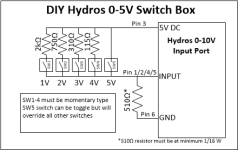
For the resistor divider, do know that there are internal protection devices on the input that throw off resistor tree calculations. Look at my DIY button box circuit to get an idea, but you may have to play with values to get exactly what you want/need. also note that the 5V internal ref isnt always perfectly 5V and can fluctuate sometimes so work that margin into your ranges as well.
 
Also simulate the situations where a float switch fails to close before a higher level switch does. you do not want 2 situations to generate the same output voltage, because then you wouldnt be able to tell what the actual state of the system is. Pulling the input to ground with a resistor also can help you bias the input to near 0 (its like 0.2V in most cases). Note that a floating input is internally biased to 2.5V as well.

This is the circuit i was referencing above.

1750357273019.png
 
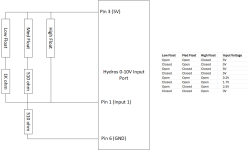
You could do something like this:
1750359499520.png

Gives you decent margin between normal states, 0.2V all open, 1.7V low closed, 3V low/med closed, 5V low/med/high closed. And also allows you to detect the case where the middle (most important) float has gotten stuck closed with a 2.5V output. I had to put the high float direct without a resistor since it gets tricky using 3 chained resistors, margins drop. But the only issue this creates is that if your top switch gets stuck, it voids the states of any of the other switches. That being said, if the top switch gets triggered, i am assuming that is an alarm state anyways to go check what's going on. Also if something gets pulled, the input would float to 2.5V which is one of your error states anyways.

But there are many ways to skin this cat, your circuit can work as well.
 
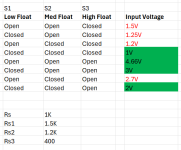
Doing with your resistor tree, would look something like this I suppose. Green are valid states. Red are invalid. 0.2V margin between valid and invalid states could be tight, but not impossible.
1750361029982.png
 
Jeff you have gone above and beyond. I owe you. Your understanding of the nuances of this circuit and its interface with the Hydros is great. I couldn't ask for more. Again thanks!
 
Back
Top