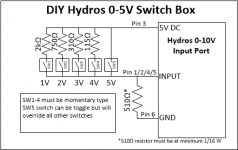
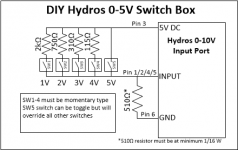
if you can guarantee that only 1 switch is closed at a time, this will work. But if there is any condition where both switches are closed at the same time, the resulting voltage will be wrong. You will have to configure the top float switch to be closed when submerged, and open when not. Then the lower switch you will need to configure the opposite as open when submerged and closed when not. This way when the water level is between the 2 float switches, neither switch is closed and only one or the other switches is closed based on if the water is over the high switch or below the low switch. You can normally reconfigure float switches by removing the clip and flipping the magnet around. Or just mount one inverted to the other one.
You could add another float as an override as well, switch 5 above in my circuit will always output 5V regardless of what SW1-4 are doing. So you could put this float at the very top of your RODI as a backup incase the top float switch failed for some case.
View attachment 1400
In summary:
Wire a lower float switch to SW1 in the above circuit, with the CLOSED state when it is not submerged.
Wire a upper float switch to SW3 (gives more error margin using 3 over 2) in the above circuit, with the CLOSED state when it is submerged.
Wire an optional overfill safety float switch to SW5 in the above circuit, with the CLOSED state when its submerged.