Interfacing Milone Technology continuous water level sensors to the Coralvue Hydros system

Users Who Are Viewing This Thread (Total: 0, Members: 0, Guests: 0)

ggdowski

Member
Joined
Oct 20, 2021
Messages
48
Reaction score
29
Location
Rochester
After posting some of this on Facebook, I was asked to start a thread here about my experiences with the Milone Technology Continuous water level sensors.
I will be adding to the thread here, but here is a little introduction.

Many types of water level detectors exist. Most however, have been discrete level detectors. More specifically, they function like a switch. If the water level is below the trigger level they turn on, and when they are above the trigger level they turn off. Many of these sensors use optics to determine water levels and they have to reside inside the tank. Newer sensors use ultrasound techniques to determine water levels and they can reside on the outside of a tank. Each of these sensors have advantages and disadvantages.

A much better way of controlling water level is by using a “continuous” water level sensor. These sensors are more like a ruler than like a switch, in that they provide a digital measure of water height. They are more advanced because they don’t just tell you the water level is low – they tell you how low the water level is. Imagine you are on vacation and your system tells you the water level is low in your tank. Wouldn’t it be great if it told you by “how much”? Such level sensors have existed for a while, but they have been fairly expensive and have been only infrequently used in the reefing hobby. As new piezo technologies evolved for measuring force and pressure, it opened the door for newer continuous water level sensors. One such device, eTape manufactured by Milone Technologies, measures continuous water level by sensing water pressure. This paper is all about how to interface this device to the Hydros control system manufactured by Coralvue.

Most of you reading this article are looking for the “pains” that are solved in using this device. Here is a running list that I created after I interfaced it successfully to the Hyrdros:
  • Continuous water level measurement provides direct feedback of where your water height is currently located.
  • It allows you to measure the exact evaporation rate of your tank.
  • It does not suffer from salt creep blocking the sensor’s optics, or snails (or other inhabitants) from occluding mechanical sensors.
  • One sensor can be used to replace multiple sensors that were used to detect low, high, and current water levels. For example, the Hydros program for RODI filtration suggests using two sensors for high and low – when this sensor could be used for both purposes. When you are thinking of implementing both an ATO and RODI filtration system -- that equates to a lot of level sensors that take up a lot of real estate on your hydros.
  • It allows you to scale warning messages based on the actual severity of the problem (eg. Water level is really low – turn off pump).
  • It is reasonably priced and is readily affordable by reefing hobbyists (current cost is $30 for a 12” sensor).
  • Different models exist for different water levels (8”, 12”, 18”, 24”, etc.).
When I first thought about interfacing this device to the Hydros, it was a bit of a gamble. I didn’t know how well it would work. I may use my optical and acoustical level sensors that I have in hand, but I am hoping to never go back. There is nothing more gratifying than looking at a display and knowing exactly where my water level is at. Simply looking at something that says “wet” or “dry” just isn’t very satisfying anymore. More to come.
 
Here is an example of what was achieved.
Tank_water_level.png

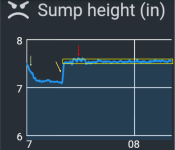
What is shown in the above figure is a continuous water level measurement of the water level in my sump displayed in inches. The signal was brought into the Hydros using one of the 0-10V input lines of my X4. I calibrated the system to the water level in my sump (I will describe this procedure in a later post). I turned off my ATO (green arrow) to allow water to evaporate down to a steady state level of about 7.2 and then reset the controller to set the level in the sump to 7.5 inches (orange arrow). The ATO came on and filled the sump until it reached 7.5 inches and maintained that level over the next day. The yellow box has a height of 0.1 inches. The water level was held within 0.1inches over that duration of time. The red arrow was when I feed my fish with the automatic feeder, when I also turn off the circulation in my display tank. The variance of water height was fairly small (<.1"). I believe the fluctuations in the water level in the figure is actual water movement in my sump caused by my skimmer.

Here are a few more advantages to this system
  • NO MORE magnets to hold sensors. I didn't want the problem of the sensor moving at all. So I created a system where it can't move. This also means no more fussing around with trying to get sensors in the right position to hold a level sensor.
  • I can set the tolerances of controlling water height based on a high and low measure within the hydros using a "generic" input as opposed to using the standard ATO settings. For example, the pump comes on when the water is below 7.45" and it goes off when it is above 7.5". There is no "wet" and "dry" states that control water level. I used the advanced setting to determine how long to leave the pump on when it is turned on.
 
@ggdowski how sensitive are these to temperature. The pressure sensors I currently use are temperature sensitive and the storage tanks I use them in are in the garage without heat. I am interested in trying these instead.
 
Awesome question. They have two sets of sensors. One is for pressure. The other is a default resistance that runs in parallel along the length of the device. That resistance is used for temperature compensation. When you bridge the two together, temperature effects them equally and by measuring differentially across the two (ie subtracting the two) you negate the majority of the effects of temperature. I have just bought a second one to put in my RODI storage unit. Hoping it will arrive shortly.
 
I guess I should state, that is what is theoretically stated in their documentation. I have implemented it, but I have not tested it. The temperature swings in my tank are really not substantial enough to impact the measurement (that is as steady as a rock).
 
This is great! Would be really nice on ATO containers, and mixing stations. I don't have an X4 but was looking at getting a wave engine for my powerheads. Any reason the 0-10v input on the wave engine could not be used for this?
 
Can you detail exactly what needs to be purchased from their site? I’d like to implement this in my Hydros.

If you can do a short how-to that would be great. Much appreciated.
 
I have been waiting to see if Jeff got his working. He bought one of their systems instead of just buying the eTape itself.
What I built looks very similar to this unit on their website.
Screen Shot 2022-03-15 at 3.39.16 PM.png
There are a number of ways to interface it. 1. Resistance voltage divider. That is similar to how the push button circuits work that you have seen on these pages. 2. There is an amplifier module 0-5V resistance to voltage converter that they provide that costs an additional $35 (total $85 plus shipping and tax). Each of those have plusses and minuses. The good news is that you can put a GX12 connector on those and connect them up to the hydros and you will be up and running (or you can hook them up directly to Jeff's breakout box for the hydros). You don't have to be a DIYer like me.

The final method uses a bridge amplifier circuit which they talk about in their documentation but that is not available on their website.
There are many advantages to using a bridge amplifier. These advantages were what I considered to be most important when I started.
  1. I wanted to optimize the device for the hydros which has a 0-10V input range. I wanted to achieve a sensitivity of 10V/12" = 0.83V/in
  2. I wanted to minimize the effects of noise.
  3. I didn't want to worry about impedance mismatches between the sensor and the hydros (this turns out to be almost a non-issue).
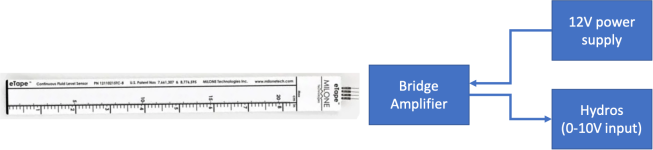
Here is a system diagram of what I put together. It included:
  1. Milone eTape Sensor
  2. Bridge amplifier (I customized a prefabricated amplifier that I found on amazon located here. $9)
  3. I used a standard 12V dc power supply that I had laying around from prior equipment.
System.png

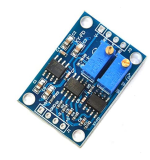
The bridge amplifier looks like this:
Screen Shot 2022-03-15 at 4.10.20 PM.png

It has two adjustable potentiometers on it (right is for offset and left is for gain). You need a 12V supply because the maximum output is 2Volts less than the supply and I wanted the maximum output to be 10V.
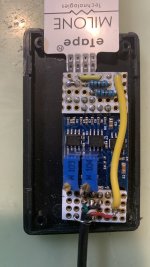
This is a picture of the 2nd prototype that I made.
prototype.jpg
I looks more complicated than it is.
I cut out to small protoboards (white perfboard) to interface to the input and output of the bridge amplifier.
The top circuit has the two resistors that were connected to form the "bridge" of the amplifier. I'll provide a circuit. These were just two 1k resistors. I also used a standard connector that the eTape could plug into.
The bottom perfboard was simply to help facilitate making the connections to the hydros.
It was then placed in a small box 3"x1.5".

Here is what the first prototype looked like. It is fundamentally the same.
Level_proto.jpg

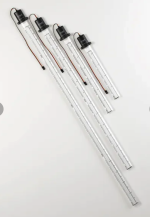
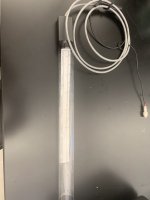
You will notice that it looks a lot like the original picture at the top of this post. I placed the eTape in a tube so that I could connect my amplifier to it at the top. The plastic tube was cut from a fluorescent bulb tube protector that you can get at Lowes. Here is the one fundamental difference from the Milone system. I cut the tube so that it would ideally hold it in my sump at the right height. That way it never moves. It rests on the bottom of the sump with the amplifier outside the sump at the top. Holes were drilled along the length to allow water into the tube. The tube also serves an important function. It minimizes level changes due to turbulence in the tank due to the skimmer. You can just dangle the eTape in the water and it will work. Just make sure it is in a space that is not subjected to a lot of turbulence that can easily cause it to move.

More to come.
 
Hi Scuba John -- I took it off-line to show some of my student in my class as an example of how to calibrate a sensor. So I had to wait for the data to refill on the hydros -- because it only stores the last 5 days (I've been begging for this to be changed for a long time).

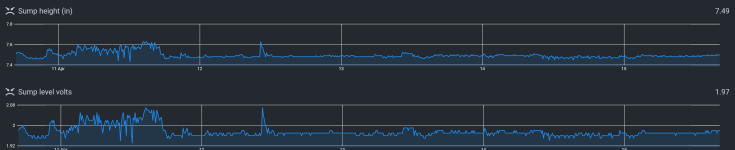
Here is a picture of the latest data.
Milone Data.png

It did manage to catch some extra water in the sump that I believe was due to my refugium going offline. In general, the ATO with the Milone keeps the water level within 0.05". It seems to work pretty well. It can catch a lot of things you might not expect, such as changes in water level when the skimmer stops.
 
I was changing out my socks this morning and I now know what that slight increase was due to on April 11th in that graph. As the socks get clogged they start causing a slightly higher level of water above the socks (as expected). When I change those out, the water level in the sump goes up slightly. It stays high until the water level stabilizes. I've also identified a relationship between the skimmer going on and shifting the DC voltage that serves as the reference for the sensor. It is temporary, but I can see it happening. At some point, I might want to add an isolated power supply that is not impacted by high current items like pumps associated with the skimmer.
 
If you had one sensor in the sump and one in the display you could program them both to not only control the ATO but you could make a program that automatically adjusts pump speed to always be balanced. No more snails/debris/urchins causing display to overfill and sump get low when tge overflow gets restricted. I've wanted to do this for a long time but never had a proper sensor with enough resolution to make it feasable.

Want to adjust turnover rate? Simply open or close your drain's gate valve and tge pump will automatically compensate it's GPH and stay silent the whole time.

Anybody understand what I'm getting at?
 
I think what you are saying is that you could adjust the pump if something were blocking a return and the water level changed. Right now...that situation is an error situation and turns off my pump and sends me an email. You would need software modifications to readjust the return pump to destabilize levels in the sump should they start to go in the wrong direction.
 
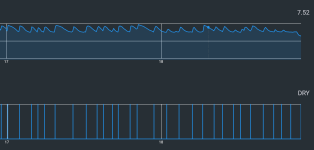
I thought I would add a fun update to this. I started using twin KLIR 7" units on my sump. Those units function by using a level sensor to measure the build up of water behind the filter as they clog. When the water level gets high, the hydros advances the filter paper --- and the water level drops. This cycle continues to repeat itself.

Well, that change in water level that is released when the KLIR filter is advanced is detectable in the lower sump with the eTape.

The top trace in the graph below is the water height in my sump as measured by the eTape.
The lower trace represents when the KLIR is activated to advance the filter paper.
Every time the filter paper is advanced, you can see the rush of water in my sump that raises its level by almost 0.25". As the filter clogs, the water level drops until the next time the KLIR advances the filter.

I can minimize the changes in water level in the sump -- but adjusting the level sensor of the KLIR. However, that causes the KLIR to advance the filter paper more frequently. At $24 for 2 rolls, I'd like to make those last as long as possible.

Interestingly, this scenario results in my ATO adjusting the water level in my tank -- when those KLIR filters are clogging (ie when the water level in my sump is at its lowest).

None of this ever really occurred to me when I was using the standard water level sensors.

water_level_update.png
 
Longer-term follow-up: after several months of using the etape in my setup, I'm not thrilled due to what I assume are temperature issues. I have two strips in use, one is mostly submerged and gives good steady values. The other is maybe 1/3rd submerged, and every now and then jumps by 1-2 cm. I'm using these in standard voltage-divider configuration, so I figured temperature was sufficiently compensated for, but... *shrug*
 
Addendum: It just occurred to me this also could be a hardware-setup issue. The sensor that is stable is at the back of the sump whereas the one that jumps around is more in the way of things. I wonder if I'm bumping the sensor every now-and-then and very subtly moving around the contacts/wires. I am also using my own assembly. Wonder if I should pony up and buy the other-branded LLS as everything should be potted and includes the 5v amp built in....

🤔

 
Addendum: It just occurred to me this also could be a hardware-setup issue. The sensor that is stable is at the back of the sump whereas the one that jumps around is more in the way of things. I wonder if I'm bumping the sensor every now-and-then and very subtly moving around the contacts/wires. I am also using my own assembly. Wonder if I should pony up and buy the other-branded LLS as everything should be potted and includes the 5v amp built in....

🤔

The Neptune LLS is just the voltage divider version as well. I’ve confirmed that by comparison
 
The Neptune LLS is just the voltage divider version as well. I’ve confirmed that by comparison

Interesting. In any case, due to the measurement/temperature sensitivity, calibration annoyances, and slow response time when the water level is lowering, these resistive sensors aren't the way to go IMO. I have a better mouse trap in the works ;-)
 
For those using an eTape sensor for a while, are you still using it? How has it performed?

Wondering if one would work in my AWC reservoir outside. Temperatures would swing from 30F-100F throughout the year.
 
Back
Top